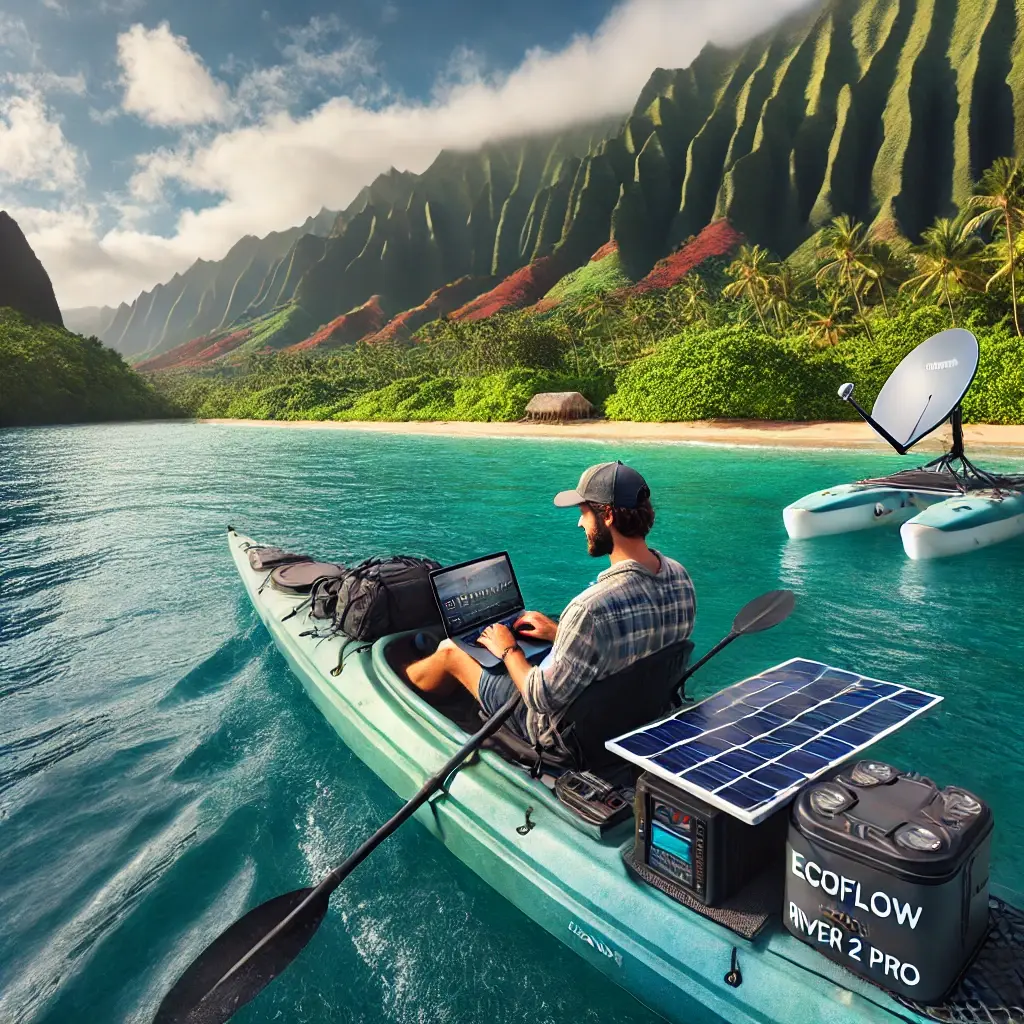
A field report from Anini Beach

Field Report • Anini Beach • Power • Bandwidth • Systems that survive reality
Power, Water, Bandwidth, and the Price of Paradise
A deeper, educational long-form dispatch—where the reef teaches redundancy, the lagoon teaches latency, and the shoreline teaches uptime.
Founder-tier systems. Privacy-first infrastructure. Automation that behaves. No beginner hand-holding.
Reef = Redundancy
Lagoon = Latency
Shoreline = Uptime
Email = Sovereignty
Automation = Leash
Listen to the episode
Drop your podcast-maker URL here later (ElevenLabs/hosted audio). This block is a placeholder.
By the time you notice the reef at Anini, it’s already done the hard work. That’s the thing about real systems—they don’t announce themselves. They absorb force quietly, offshore, where the damage never makes the headlines. The water looks calm because the violence has already been handled: broken down, dispersed, metabolized.
On the North Shore of Kauaʻi, that lesson isn’t poetic. It’s practical.
On a morning when the island feels like it’s holding its breath—trade winds low, light bending soft across the lagoon—Benjoe is barefoot in the sand, talking about email servers. Not in the abstract. Not as a metaphor. As infrastructure. As survival.
He runs MyComputerTherapy, a name that sounds gentle until you realize it’s an intervention. This isn’t “IT support.” This is triage—designed for founders, operators, and entrepreneurs who already know enough to be dangerous and are sick of bleeding attention into tools they don’t trust. Benjoe doesn’t teach people how to send email. He teaches them how to stop renting their nervous system.
Real systems don’t announce themselves. They just keep the shoreline intact.

The Beach Is the Syllabus
Anini Beach isn’t a backdrop here. It’s a curriculum.
The reef is redundancy—multiple layers designed to fail gracefully instead of catastrophically. The lagoon is latency—buffered, predictable, forgiving. The shoreline is uptime—the only part anyone actually sees, judges, or relies on.
You learn fast on Kauaʻi that romance is expensive and physics always collects. The island doesn’t care about your intentions. It cares about load, stress, heat, and time. That’s why Benjoe builds systems the way he does.
Quick education: the three-layer model
- Redundancy keeps the system alive when parts fail.
- Latency buffers keep performance predictable under load.
- Uptime is what the user experiences—everything else exists to protect it.
The Math Behind the Vibe
Off-grid life is marketed like a mood board. Sun-kissed panels, tidy battery boxes, a laptop glowing heroically at sunset. The reality is math.
A hundred-watt solar panel costs about a hundred dollars now. That sounds democratic—until you derate it. Clouds. Angle. Salt haze. Heat. On a good day, sixty percent is honest. On a bad day, you learn humility.
Battery packs are everywhere now—Costco, Home Depot, glossy packaging promising freedom. But batteries don’t care about optimism. They care about load curves, surge draw, inverter behavior, and thermal limits. Ignore those variables and you don’t get enlightenment. You get a blackout.
Starlink Mini is the one luxury Benjoe doesn’t apologize for. Around one-seventy a month buys you leverage—if the rest of your system isn’t lying to you. Bad power makes bad internet. People curse the satellite when the problem is the wiring, the grounding, or the inverter they never bothered to understand.
Don’t blame the tool. Fix the foundation.
Quick education: off-grid power in plain terms
- Watts = how fast you’re spending energy.
- Watt-hours = how much energy you actually have stored.
- Surge = the startup punch that trips cheap inverters.
- Derating = real-world output after heat, angle, cloud, and losses.

Creation Stations, Not Toys
Benjoe doesn’t sell gadgets. He builds what he calls creation stations—environments where thinking can happen without constant interruption.
For a billionaire, that means privacy, resilience, and clean operations. No dependency traps. No surprise outages. No third-party platforms quietly rewriting the rules mid-quarter.
For a local entrepreneur, it’s the same philosophy at a scale that hurts sooner. One failure doesn’t dent a portfolio—it jeopardizes rent, payroll, momentum. The philosophy doesn’t change. The blast radius does.
The stack is deliberately unsexy: containers over chaos, services that don’t fight each other, communication you own. Email servers aren’t nostalgia here—they’re sovereignty. Privacy isn’t a luxury item. It’s operational integrity.
This is where RobotTrainer.net enters—not as a shrine to artificial intelligence, but as a leash. Benjoe trains automation like a working dog: boundaries, inputs, a defined job. Without that discipline, intelligence becomes expensive noise wearing a friendly face.
Quick education: why containers win
- Isolation: one service breaks, the rest stays stable.
- Reproducibility: you can redeploy the same system anywhere.
- Upgrades with control: fewer surprise collisions and plugin wars.
Why Radio Still Matters
The project sprawls because the mind does. Alongside the infrastructure work, Benjoe runs Tune Into Tomorrow, a long-form radio show built deliberately against the grain of short attention and shorter memory. Voice matters. Silence matters. Coherence matters.
On an island where brilliance often drowns in distraction—tourism, hustle, algorithmic noise—radio becomes a frequency you can tune to when everything else is screaming. It’s not content. It’s cadence.
It’s not content. It’s cadence.

Water Teaches Faster Than Code
Ask Benjoe about kayaks and the smile fades. Experience shows up. Paddle curvature matters. Blade angle matters. Cheap paddles don’t just slow you down—they turn into slow injuries. Out here, owning a kayak is not the same thing as operating in water that doesn’t care about your plans.
Safety gear isn’t optional. PFDs. Leashes. Signaling. Dry bags. Redundancy. The ocean is generous—until it isn’t.
Camping follows the same ethic. Light shelter. Fast setup. Gear that doesn’t pretend it’s somewhere else. Salt and sand audit everything. Six Moon Designs over palaces. Bring what you can manage when you’re tired, wet, and annoyed.
Permits Are Pressure Valves
Kalalau enters the conversation the way it should: carefully. Not as content. Not as a flex. As a living system with limits. Permits aren’t bureaucracy—they’re pressure valves. Love a place without restraint and you kill it.
That’s why Kalalau Guardians exists: to keep people alive and the land intact. Stewardship here isn’t branding. It’s consequence management.
The Cost of Paradise
There’s no romance in firewood. There’s labor, time, and the physics of shipping everything to the middle of the Pacific. Firewood here is expensive because everything here is expensive. When the rest of the world catches up, Kauaʻi raises the price again.
It’s not cruelty. It’s demand meeting reality.
Benjoe keeps his hands in the dirt on purpose—weed-whacking, hauling, splitting. Call it Shave-a-Nini. Tech people who never touch reality build imaginary castles. Dirt keeps the designs honest.

Flyers as Filters, Not Ads
The flyers are crooked on purpose. Bulletin boards are a test. Scan a QR code off cork and you’ve already passed. Different flyers lead to different depths: an introduction, a deep interview, a power-and-bandwidth episode, the radio feed. You choose how far you go.
This isn’t funnel thinking. It’s filtration.
The Turn You Don’t Expect
Then there’s the turn people don’t see coming. Shells. Design. Print. Fashion.
The forthcoming Bank of Sally Shore project treats shells as data—time, friction, discipline, beauty. The same philosophy migrates from servers to magazines to clothing. Easter is the hinge. The punchline isn’t public yet.
The Quiet Invitation
There’s no confetti here. No countdown timer. No webinar pitch. If the signal hits, you already know what to do. A conversation decides everything. As systems improve, they get quieter. Technology doesn’t need to be loud.
On Anini Beach, the reef keeps working. That’s the lesson.
Start the conversation
Founder-tier systems. Privacy-first infrastructure. Clean stacks. Rapid triage. Calm outcomes.
Optional direct line: benjo@mycomputertherapy.com
Explore the ecosystem
Easter hinge: Bank of Sally Shore (spring signal) — not public yet.
Studio Pickups (Conversational Seeds)
These are short conversational prompts to help ElevenLabs (or a real co-host) “pick up” the narrative and re-render it into dialogue again.
- Jack: “So when you say the reef is redundancy… what’s the human version of that?”
- Benjoe: “It’s margins. It’s backups. It’s not betting your life on one tool.”
- Jack: “Give me the real solar numbers—what do people think they’re buying?”
- Benjoe: “They buy 100 watts and get 60. Then they get mad at physics.”
- Jack: “Starlink at $170—who should actually pay that?”
- Benjoe: “The people who need leverage—uploading, responding, building—no excuses.”
- Jack: “Containers: explain it like a beach person, not a dev blog.”
- Benjoe: “One service breaks, the others don’t catch the sickness.”
- Jack: “What’s the line between privacy and paranoia?”
- Benjoe: “Privacy is integrity. Paranoia is fear without a plan.”
- Jack: “Kayaks—what’s the fastest lesson the ocean gives?”
- Benjoe: “Owning gear isn’t operating. Safety isn’t optional.”
- Jack: “Permits—why do you call them pressure valves?”
- Benjoe: “Because places get loved to death. Limits keep them alive.”
- Jack: “What’s the crooked flyer strategy, really?”
- Benjoe: “It’s a filter. If you scan off cork, you’re my people.”
- Jack: “RobotTrainer—why ‘leash’ instead of ‘shrine’?”
- Benjoe: “Because automation should serve humans, not hypnotize them.”
- Jack: “Bank of Sally Shore—give me the Easter hint without spilling it.”
- Benjoe: “Shells are data. Time and friction become design. That’s the signal.”